
Only Gallagher harnessed social media in #Aras11 race
In the early days of the presidential race, Pat Kenny held an illuminating interview on the value of social media in an election campaign. On September 5, he interviewed Ewan McIntosh, a social media strategist who co-directed a “digital election arms race” that helped the Scottish National Party (SNP) sweep to an historic majority in May of this year. The strategy involved a “daily cycle of news", which "enthused volunteers" and "allowed people to feel ownership of the party”. Party members co-ordinated efforts on Twitter and Facebook to spread party messages. Crucially, the campaign was timed to build a crescendo of support on polling day. By Malachy Browne.
[A version of this article was first published in the Irish Examiner, October 25.]
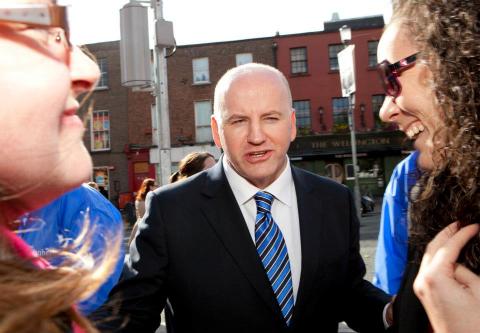
Sean Gallagher is the only candidate in the presidential field to remotely emulate SNP's strategy. Of all seven online campaigns, Gallagher's is the best organised and has attracted the greatest level of interest by far in recent weeks. Gallagher too is building to a crescendo in these final days: He added 4,000 new Facebook fans between Sunday evening and Tuesday evening (25 October) bringing his total to over 39,300. Comparatively, Michael D. Higgins has 4,500 Facebook fans in total and Gay Mitchell has 1,300. On Twitter too, Gallagher performed well, attracting 4,000 new followers in October, compared with 1,200 for nearest rival David Norris.
A revealing insight is the "talking about this" statistic on Facebook – it gives a snapshot of the people engaging and personally recommending a page. On Sunday, some 11,000 people were "talking about" Gallagher's page on Facebook, four times more than Martin McGuiness (at 2,430) and seven times more than David Norris (1,561).
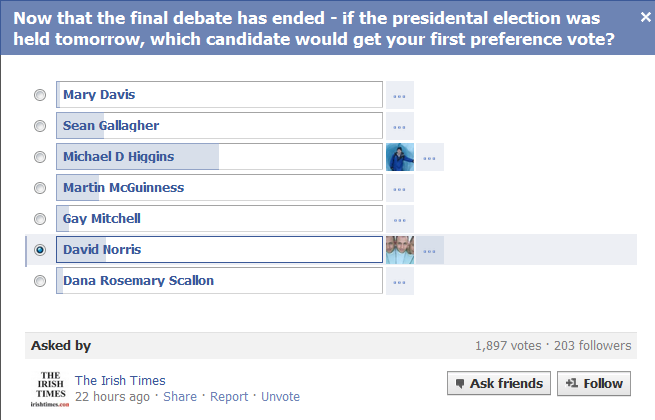
However, Gallagher's popularity on social media appears to have taken a dent following his performance during the final Presidential debate on RTE's Frontline Monday night. Many people clearly percieve as unsatisfactory Gallagher's repsponse to questions about the erroneous lodgement of business funds in his account, and his alleged messengering of a Fianna Fail donation in 2008. An Irish Times poll conducted on Facebook showed Gallagher at 14.5% (245 of 1897 votes); Michael D Higgins polled at almost exactly 50%.
Back to Facebook's "talked about" statistic. What people are in fact "talking about" remains something of a mystery. While each of the candidates has a presence on Twitter and Facebook, none has truly engaged with people online. Gallagher is no different to the other candidates in using the tool primarily as a "push" mechanism to market their campaign. Very few have used social media to glean an insight from the electorate. All candidates respond to online messages of support, but in researching this article I did not encounter one candidate asking followers a question.
Part of the problem is that most of the messages are sent by campaign teams. Rarely do messages feel personal, or give an insight to the candidate, with the exception of David Norris who on Sunday tweeted, "I'm by my fire to watch @StephenFry & I discuss the words of Joyce on #PlanetWord 9pm BBC2."
Such is the prevalence of Gay Mitchell's whereabouts on his Twitter stream, one could be forgiven for thinking he is fitted with an electronic tracking device that tweets on the hour. The other candidates are equally guilty of this and posting opportunistic photos. Some personable photos do appear among the hundreds of photos on Sean Gallagher's Facebook page, however.
The creation of accounts on Facebook, Twitter and YouTube coincided with Mary Davis' declaration of intent in April. This presented an opportunity to test her message online and to grow an online "grass roots" as she campaigned across the country. However, her social media following languishes, just as her opinion poll rating.
Dana is by far the least present on social media. At the start of October she had neither a Twitter or Facebook page. She now has a token presence on each, but her team cross-posts long messages from Facebook to Twitter, meaning her message is often lost in the latter.
A feature of this campaign is the abject failure of the political parties to support their nominated candidate online in a centralised and co-ordinated way. Each has availed of the party press office to send press releases via email. However, the social media presence of party colleagues has not been harnessed. Labour TD's occasionally tweet when they campaign with Michael D. Gay Mitchell mentions colleagues on Twitter, some of whom are close to dormant on social media. Various Sinn Fein accounts have been adept at supporting Martin McGuinness, something reflected in his Facebook following and YouTube viewership - both of which are high relative to his opinion poll ratings.
Facebook sets itself apart from other mediums in translating to actual votes. A study by Dr Ciarán McMahon of Candidate.ie noted that Facebook following in Ireland's general election directly correlated with a candidate's first preference votes. As Dr McMahon noted, people are likely to follow just one Facebook page and more likely to follow several candidates on Twitter. In other words, a Facebook 'like' is a pledge of allegiance.
Dr. McMahon has been tracking the social media following of the candidates since July and said in an interview that "it was alll Gallagher" and "only a matter of time" before the traditional opinion polls reflected this. Of all Facebook 'likes' cast for these candidates, Gallagher accounted for 45% on Sunday evening. His success can be credited to his campaign team and the online marketing company Simply Zesty who Gallagher contracted in mid-August to help his online presence. Part of this strategy has been to use Facebook ads to build momentum. He intends to continue this in the final week, just as the SNP did in the dying days of the Scottish election.
In those closing days, the SNP aggressively advertised the line "Both Votes, SNP". It was fresh in voters' minds as they ticked the ballot.
Gallagher unquestionably lost some of his 13% opinion poll lead on Michael D after the Frontline debacle. To copperfasten his position, Michael D could do worse than to follow the SNP's example and lobby other candidates to spread the viral message, "Vote 2, Michael D".
{jathumbnailoff}
A table below outlines the social media stats of various candidates. Historical data is courtesy of Candidate.ie.